



Our patients are treated according to the latest standards in dentistry as well as with the highest possible level of safety and professional competence
Click on the links below to learn more about the services that we offer.

Professional dental cleaning is an important part of maintaining healthy teeth and gums.
Even with regular and thorough brushing at home, plaque cannot always be completely
removed.
By carefully removing plaque and tartar, professional cleaning helps prevent
bacteria-related conditions such as cavities and gum disease.
We primarily use modern scalers, curettes, and ultrasonic devices. For heavier staining
or upon request, we also offer Airflow treatment, which gently and effectively removes
stubborn deposits and discoloration.
Tooth fissures are fine grooves or pits on the chewing surfaces of molars, located
between the cusps of the teeth. These areas can be challenging to clean during daily
oral hygiene, as the deepest parts of the fissures are often narrower than toothbrush
bristles.
To protect the tooth enamel, a fissure sealant can be applied. During this procedure,
the tooth surface is gently prepared and then sealed with a thin protective resin layer,
significantly reducing the risk of tooth decay in these hard-to-reach areas.
Tooth decay is a disease of the hard tooth structures that causes the loss of minerals
from the tooth surface. This process weakens the tooth and can lead to long-term damage.
Fluoride treatment is an effective preventive measure against tooth decay. It helps
inhibit decay-causing microorganisms while supporting remineralization, strengthening
the enamel and helping to rebuild the tooth structure.
During fluoride treatment, the trace element fluoride is applied as a special fluoride
varnish to vulnerable areas of the teeth, such as the tooth necks.
Dental fillings are used to reliably repair various types of tooth damage. In addition
to cavities or chipped teeth, fillings are increasingly used to treat wear-related
damage and erosion caused by brushing or acidic substances.
We use only tooth-colored composite fillings. These are applied in layers to the damaged
tooth and hardened with a special curing light, resulting in a durable, stable, and
natural-looking restoration.
Teeth whitening, also known as bleaching or whitening, refers to restoring or lightening
the natural color of the teeth using special bleaching agents.
After a professional dental cleaning, the gums are carefully protected with a silicone
barrier, and the bleaching agent is applied to the teeth.
To speed up the treatment while keeping it as gentle and comfortable as possible, we use
a special LED light.
Periodontal pocket cleaning as well as root-planing is an important part of periodontal
treatment. It includes thorough cleaning of the gum pockets (curettage), disinfection,
and smoothing of the tooth roots.
This treatment helps reduce bacterial reattachment and effectively treats and prevents
gum disease. To ensure the procedure is as comfortable and pain-free as possible, the
area is numbed with local anesthesia.

A non-restorable tooth is a tooth that must be removed due to severe looseness, a
fracture, a non-healing infection, or other medical reasons.
The procedure is usually performed under local anesthesia. The tooth is gently removed
from the socket, after which the area is thoroughly cleaned and any inflamed tissue is
removed if necessary.

After a tooth extraction or in cases of severely damaged, broken, or fractured teeth,
parts of the tooth roots may sometimes remain in the jawbone.
Root remnants that are located deep within the bone or displaced (impacted) teeth cannot
be removed easily and therefore require surgical removal.

Many dental problems develop below the gum line and are not visible to the naked eye.
Dental X-rays are therefore an important diagnostic tool that allows early detection of
damage to teeth, bone, and surrounding tissues.
A single dental X-ray image usually captures up to four teeth and provides highly
detailed and sharp images.
To accurately visualize the target tooth, the X-ray film is placed on the tongue side
directly behind the tooth inside the patient’s mouth. It is held in position either by
the patient or with the help of special X-ray holders. The area is then imaged using a
modern handheld X-ray device.
In contrast to a single-tooth X-ray, this is a large panoramic image that shows the
entire jaw, all teeth, the jaw joints, and certain bony structures of the head, such as
the sinuses.
This allows the dentist to quickly obtain a comprehensive overview of the condition of
the teeth and the jawbone.
For the panoramic X-ray (OPG), the patient stands in front of the X-ray unit and remains
still for about 15 to 20 seconds while the device rotates once around the head.

3D X-ray imaging, also known as Cone Beam Computed Tomography (CBCT) or Digital Volume
Tomography, provides a three-dimensional view of the teeth, jawbone, nerve pathways, and
surrounding anatomical structures. Unlike conventional X-rays, it delivers highly
precise and detailed images from all spatial angles.
This technology is especially valuable for implant planning, surgical procedures, the
assessment of impacted teeth, and the investigation of unclear pain or findings. It
allows the dentist to gain an accurate spatial overview and to plan treatments safely
and precisely.
During the scan, the patient stands still while the X-ray unit rotates once around the
head. The examination takes only a few seconds and is performed with the lowest possible
radiation exposure.
If tooth decay or a fracture caused by an accident has severely damaged a tooth and a
filling is no longer sufficient due to the size of the defect, a dental crown may be
recommended.
A dental crown is like a protective cap that restores the natural shape of the tooth and
is permanently cemented onto the prepared tooth. Crowns can be made from three different
materials, with the main difference being the inner framework that provides stability.
The outer surface is covered with ceramic, giving the crown a natural, tooth-like
appearance.
The treatment is performed under local anesthesia. First, the tooth is carefully
prepared and a precise impression is taken. The crown is then fabricated in our in-house
dental laboratory, either using a physical model or digital design technology.
While the final crown is being made, the patient wears a temporary plastic crown. After
checking the fit of the framework and the finished crown, minor adjustments are made to
the height and contact points with neighboring teeth before the crown is permanently
cemented.
A dental bridge is a fixed dental restoration consisting of at least two crowns, known
as bridge anchors, which are connected by one or more bridge units that replace the
missing tooth or teeth. The adjacent teeth serve as supporting pillars for the
bridge.
With a dental bridge, one or more gaps can be permanently closed, restoring both the
appearance and function of missing teeth. Alternative treatment options include dental
implants or removable dentures.
The procedure is performed under local anesthesia. The supporting teeth are carefully
prepared and a precise impression is taken. Similar to a crown, the bridge is then
fabricated in our in-house dental laboratory, either using a physical model or digital
design technology.
While the final bridge is being made, the patient wears a temporary plastic bridge.
During the try-in of the bridge framework, not only the fit but also tension-free
positioning and stability are carefully checked. At the final appointment, after minor
adjustments to the height and contact points with neighboring teeth, the bridge is
permanently cemented.

To replace a missing tooth, a dental implant can be chosen as a fixed alternative to a
dental bridge. The implant is placed into the jawbone and serves as a stable anchor for
a crown or bridge, similar to a natural tooth root.
After a thorough examination and careful planning, the implant (NEOSS) is precisely
inserted into the jawbone using specialized drills. The
procedure is performed under local anesthesia, is painless, and usually completed within
one hour.
To allow the artificial tooth root to heal properly, the gum tissue is closed over the
implant. The sutures are typically removed after about one week.
As the bone needs time to grow onto the implant’s specially designed surface, a healing
period of approximately 3 to 6 months is required. After this phase, the final fixed
restoration—either a crown or bridge—can be attached or cemented within 3 to 4 days.
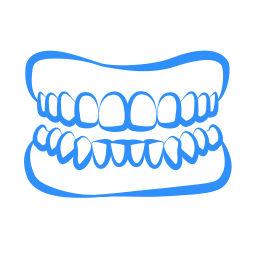
A complete denture is used when all natural teeth are missing in the upper and lower
jaw. It replaces the entire set of teeth and restores both chewing function and facial
appearance.
The denture is individually fabricated from high-quality acrylic and precisely adapted
to the shape of the jaw and gums. It rests on the jaw and is held in place by a
combination of suction, saliva, and the natural movement of the lips, cheeks, and
tongue.
Since there is no fixed anchorage like natural teeth or implants, achieving a stable
fit—especially in the lower jaw—can sometimes be challenging. However, with careful
adjustment, a short adaptation period, and regular follow-up visits, comfortable eating
and clear speech can usually be achieved.
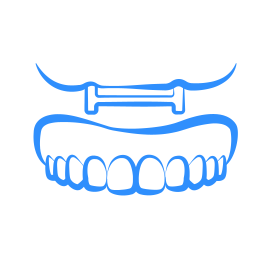
With this type of removable dental restoration, a bar is securely screwed onto at least
two implants placed in the jaw. The denture features a precisely fitted attachment on
its underside, allowing the patient to easily and safely insert and remove it.
The use of additional implants or bars significantly improves the stability of the
denture, resulting in greater comfort and increased security when speaking and
chewing.
After a thorough examination and careful planning, the implants (such as NEOSS or
STRAUMANN) are precisely placed into the jawbone using specialized drills. The procedure
is performed under local anesthesia, is painless, and usually completed within 1 to 2
hours.
To allow proper healing of the artificial tooth roots, the gum tissue is closed over the
implants. The sutures are typically removed after about one week. As the bone needs time
to integrate with the implant’s specially designed surface, a healing period of
approximately 3 to 6 months is required. During this time, any existing dentures may
need to be modified, as the implants must not be loaded too early.
After successful healing, the final denture can be fabricated and fitted within
approximately one week.
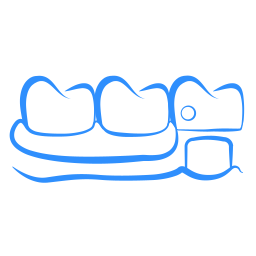
A unilateral free-end denture is used when the molars on one side of the jaw are
missing. Because small, one-sided dentures can carry a risk of accidental dislodgement,
German regulations require these restorations to be securely retained.
For this reason, our free-end dentures are stabilized using a prefabricated titanium
attachment system (KeySlide). This mechanism ensures that the denture remains securely
in place at all times and can only be removed intentionally by the patient. Removal is
possible only after unlocking the denture by pressing a small release button.
For the treatment, the last two remaining teeth on the affected side are prepared and
restored with telescopic crowns. The denture is then fitted with the locking mechanism
and securely attached to the telescopic crowns, allowing it to be firmly seated while
still being easy to unlock and remove when necessary.
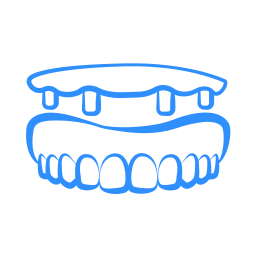
A telescopic bridge or telescopic prosthesis is an externally invisible removable denture that is anchored to the remaining teeth or, in case of a toothless jaw, to implants. Since this type of denture c onsists of a fixed part (the telescopic crowns) and a removable part (the actual tooth bridge or dental prosthesis), these partial dentures are also called hybrid dentures. Telescope restorations have a number of advantages in comparison to other systems.

Root canal treatment is a well-established dental procedure used to remove infection
from inflamed or dead teeth and thereby prevent their extraction. The primary goal of
the treatment is to preserve the natural tooth.
Under local anesthesia, the dentist creates a small access opening on the chewing
surface of the tooth to reach the fine nerve canals inside. Using specialized, delicate
instruments, the infected or dead nerve tissue is removed, the interior of the tooth is
thoroughly cleaned, and the individual root canals are carefully shaped.
Depending on the severity of the infection, the treatment may require multiple
appointments. Between visits, a medicated dressing is often placed inside the tooth and
the access opening is temporarily sealed to support healing.
Once all root canals have been completely cleaned and disinfected, they are permanently
sealed with a dense filling material.
As a tooth becomes more fragile after root canal treatment, it is usually recommended to
reinforce it with a post (pin) and a crown to ensure long-term stability and function.

After a root canal treatment has been completed, a revision may be necessary in certain
situations. This can be the case if persistent or recurring pain occurs, or if new
inflammation develops at the root tips or existing inflammation fails to heal
properly.
A revision may also be required for prosthetic reasons, for example when new
restorations such as crowns or bridges are planned. Questionable or insufficient root
canal fillings should be renewed before placing new prosthetic work in order to ensure
long-term treatment success.
During a root canal revision, the existing root filling is completely removed. The
entire canal system is then carefully re-instrumented, mechanically and chemically
cleaned, and thoroughly irrigated to reliably eliminate any remaining bacteria.

The root anatomy of a tooth can be as complex as the root system of a tree. For this
reason, each root canal treatment must be individually planned and carefully performed.
Very fine, curved, or calcified canals, as well as complex branching or hard-to-locate
canals, require significantly more time and the use of specialized instruments compared
to a standard root canal treatment.